
Originally published June 9, 2025
Last substantially revised October 27, 2026
Why do some people have gaps in their childhood memories, and what role can trauma play?
Many people have limited memories of childhood. For some, however, the gaps feel more significant, leaving questions about experiences they cannot fully recall.
While what underlies gaps in memory is complex and not fully understood, this blog post focuses on how memory loss can occur following trauma or abuse.
What Is Trauma-Related Amnesia?
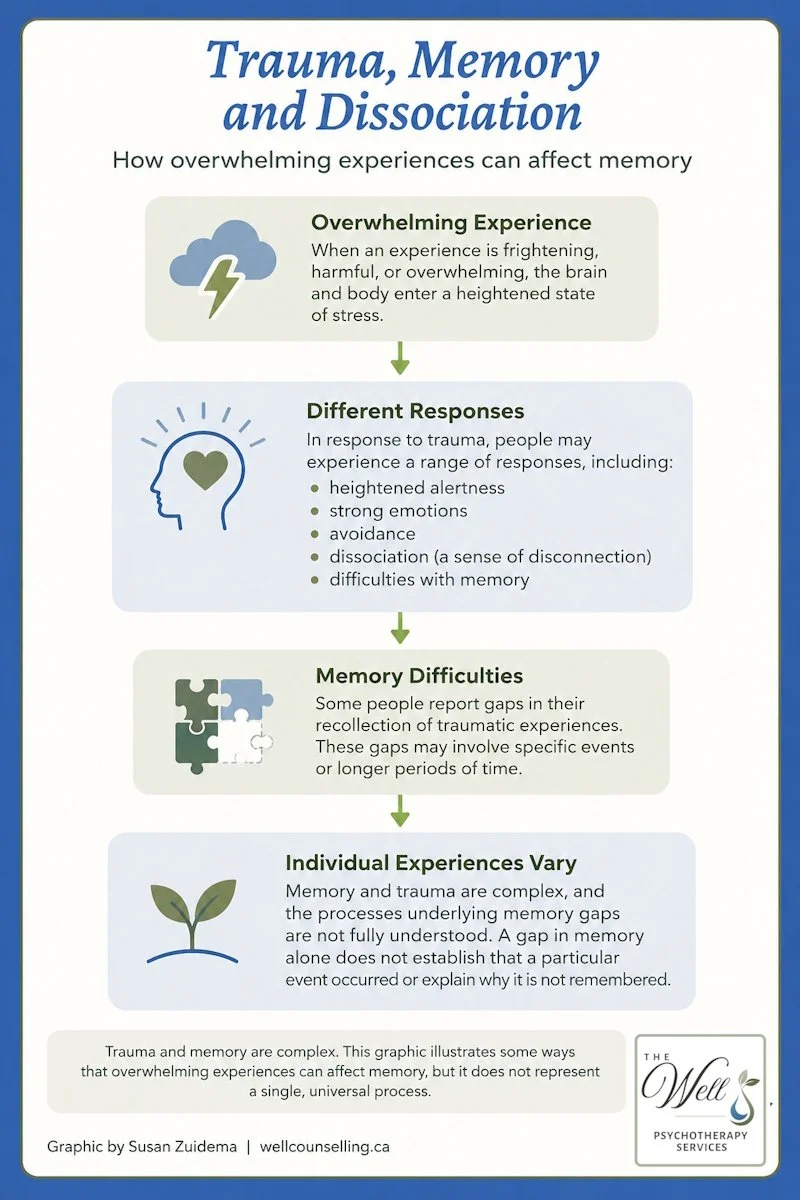
Amnesia refers to an inability to recall information or experiences. In some circumstances, people who have experienced trauma report gaps in their autobiographical memory, including difficulty recalling particular events or periods of their lives.
Dissociation can sometimes occur in response to overwhelming experiences. It involves a sense of disconnection from one’s thoughts, feelings, memories, surroundings, or sense of self. Dissociative amnesia is a specific condition involving difficulty recalling important personal information that cannot be explained by ordinary forgetting.
Memory difficulties vary from person to person. A gap in childhood memory, on its own, does not establish that abuse or another traumatic event occurred.
How Can Trauma Affect Memory?
When an experience is overwhelming or frightening, stress can affect how a person attends to, processes, and remembers what is happening. Some people later have difficulty recalling aspects of the experience.
For children, traumatic experiences may be especially complicated when the person causing harm is also someone they depend on for care and protection. Conflicting feelings, fear, and disrupted trust can make these experiences difficult to process.
Researchers have explored links between trauma, betrayal, dissociation, and memory difficulties. However, the processes involved are complex, and no single explanation applies to everyone.
Trauma can influence how childhood memories are held and accessed by the brain.
Can Trauma Memories Return?
Some people report remembering experiences they could not previously recall, while others continue to have gaps in their memories.
It is important to approach these experiences gently. A dream, image, strong emotion, bodily sensation, or emerging recollection does not, by itself, establish that a particular event occurred. Memory is reconstructive, and remembering something after a period of time does not automatically confirm its accuracy.
Therapy should not involve pressure to recover memories or reach a particular conclusion about the past. The focus can instead be on understanding present-day feelings, difficulties, and patterns, while respecting uncertainty and each person’s pace.
How Can EFIT Help?
Emotionally Focused Individual Therapy (EFIT) offers a way to explore difficult emotions and patterns within a supportive therapeutic relationship.
For someone troubled by gaps in their childhood memories, therapy does not need to begin with uncovering what happened. It can begin with what they are experiencing now: anxiety, shame, grief, disconnection, difficulties with trust, or a sense that something feels unresolved.
An emotionally attuned therapist can help clients make sense of these feelings, develop greater emotional safety, and explore how past experiences may be affecting their lives today. The work proceeds at a pace that feels manageable, without pressure to disclose, remember, or interpret anything before the client is ready.
You do not need to recover memories or prove that something happened to deserve support.
You Deserve Support, Even When the Past Feels Unclear
Having gaps in your childhood memories can bring up questions, uncertainty, and difficult emotions. You don't need to have all the answers—or know exactly what happened—to seek support.
At The Well Psychotherapy Services, we offer individual therapy in Brantford and online across Ontario. Using an emotionally focused, attachment-based approach, we can help you explore your feelings and experiences at a pace that feels safe and manageable, without pressure to remember or disclose anything before you're ready.
You don't have to make sense of everything on your own.
Book a Free ConsultationReferences
American Psychiatric Association. (2013). Diagnostic and statistical manual of mental disorders (5th ed.). American Psychiatric Publishing.
Joseph, R. (2003). Emotional trauma and childhood amnesia. Consciousness & Emotion, 4(2), 151–179. https://doi.org/10.1075/ce.4.2.02jos
Ross, C. A., et al. (2022). Reversal of amnesia for trauma in a sample of psychiatric inpatients with dissociative identity disorder and dissociative disorder not otherwise specified. Journal of Child Sexual Abuse, 31(5), 556. https://doi.org/10.1080/10538712.2022.2067096
Schönfeld, S., et al. (2007). Overgeneral memory and suppression of trauma memories in post-traumatic stress disorder. Memory, 15(3), 341. https://doi.org/10.1080/09658210701256571
Wagner, N. M. (2013). Sexual revictimization: Double betrayal and the risk associated with dissociative amnesia. Journal of Child Sexual Abuse, 22, 883. https://doi.org/10.1080/10538712.2013.830666